

Research Reports
The main purpose of this study is to new devise models of cooperation with industries in the Changjiang River Delta, which is the most advanced region in China. In contrast to previous research, this study acknowledges how changes in the exogenous trade and industry environment, including rising trade protectionism, technology and even the COVID-19 pandemic have become very important factors in Foreign Direct Investment. Therefore, this study suggests customized strategies for selected industrial sectors for cooperating and investing in/with the Chiangjiang River Delta area.
This study differs from the extant literature in four ways. First, it analyzes and describes clearly the two areas of trade and direct investment. Second, in this study, organic cooperative research was prompted through mutual discussion over distinct roles among research institutes. Third, the core content of this research materialized when the principal subject of analysis was narrowed down from China as a whole to the Changjiang River Delta specifically. Fourth, the most important contribution of this research is the customized policy suggestions across target sectors that consider specific areas and avenues for investment, corporate strategies, Korean government support, and so on.
After opening up in 1978, China has become the fastest-growing economy and has even been able to overtake the US in terms of total economic volume. The Trump administration of the U.S. consistently sought to pressure China through the imposition of tariffs and the protection of cutting-edge industrial technologies. China is expanding investment to gain the upper hand in the future by building digital infrastructure while lowering its dependence on U.S. technologies and enhancing domestic research and development. Meanwhile, Japan imposed sanctions on exports of semiconductor materials to Korea for political reasons. Furthermore, the spread of COVID-19 led to an economic downturn and ushered in an “untact” culture, boosted the online economy and promoted the rapid stimulation of digital technologies. Therefore, when it comes to foreign direct investment, we need to comprehensively assess the stability and sustainability of the supply chain, review production location issues and calculate political risks, among other issues.
The Changjiang River Delta is one of China’s three super metropolitan areas, along with the Capital Area and Zhujiang River Delta, but in substance, it is the heart of China’s economy. It is composed of four states: Shanghai, Jiangsu, Zhejiang, andAnhui. The population of the Changjiang River Delta is about 167 million as of 2020 and the gross regional domestic product came to about 23.7 trillion CNY in 2019, which is about 21.3 percent of China’s gross domestic product. The service industry, including the finance and logistics sectors, are heavily concentrated in Shanghai, while the information communication technologies (ICT) and platform economy sectors are located in Hangzhou. The automotive manufacturing, display and semiconductors are concentrated in Jiangsu and traditional manufacturing and agricultural sectors are in Anhui.
The trade volume between Korea and the Changjiang River Delta accounts for about 35.2 percent of total trade volume between Korea and China. About 84.4 percent of imports to Korea from the Changjiang River Delta are intermediate goods and 64.5 percent of Korean exports to the region are also intermediate goods, Among the aforementioned four states, trade volumes with Jiangsu are the biggest. Korean FDI to China is heavily concentrated in Jiangsu and Shanghai. Since 2016, the portion of direct investment to Jiangsu accounts for 34.8 percent of all FDI to China. The purpose of the direct investment to Changjiang River Delta is for the local market. On the other hand, Korean companies in China seem to lose their competitiveness and appear very vulnerable to frictions between the U.S. and China and even COVID-19.
Considering direct investment in the Changjiang River Delta, it is necessary to review the development plan of the area. Policies including the the One Belt One Road initiative, China Manufacturing 2025, Strategic New Industries and Local Industries are supposed to be screened and be utilized. For effectiveness of direct investment, the Free Trade Zone should be given priority.
Super Metropolitan Economic Area Cooperation between the Dongnam Area in Korea and the Changjiang River Delta may generate new synergies through cross-industrial cooperation. Such cooperation could be undertaken based on the Korea Strait Economic Bloc at the logistical level, and thus could function as a lubricant of trilateral cooperation between Korea, China and Japan in the future.
Three criteria were applied to the selection of promising direct investment sectors in the Changjiang River Delta: fundamental location decisions, the Changjiang River Delta development plan and Korean comparative advantage. As a result, five manufacturing industries and three service industries were selected: the automotive, home appliance, aerospace manufacturing, system semiconductor and hydrogen industries.
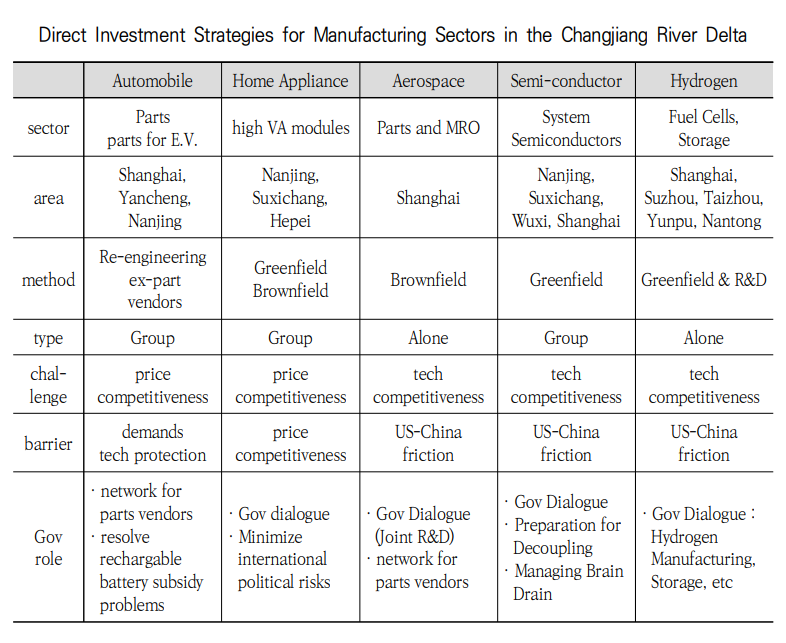
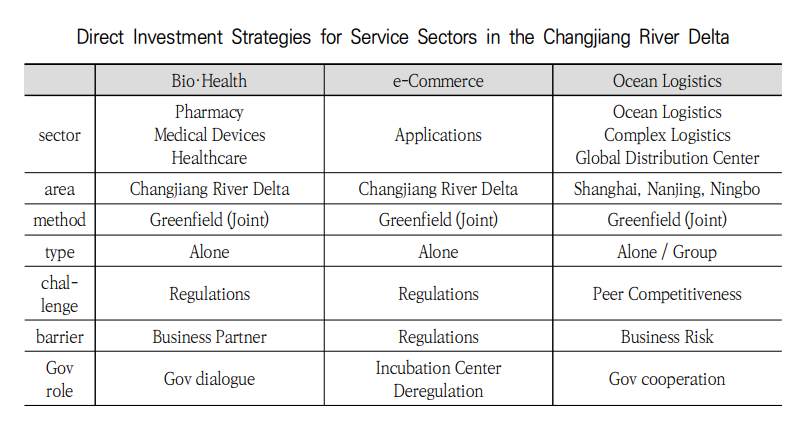
This study serves to focus attention on three key issues. First, exogenous factors, such as international political risks, should be considered. Second, reviewing China’s government policy review is crucial. Finally, any FDI strategy should be customized. Factors to consider include the region, sector, method of investment, type of investment, looming challenges and the role of government.

The works on this page are licensed for fair use under the provisions of the Korea Open Government License. See kogl.or.kr for more information.
Please enter the security text below
to prevent email collection
Please check the information of the person in charge.
연구과제 제안이 접수되었습니다.
신청이 접수되었습니다.

View Summary
코로나19 발생 이후 대부분의 고용 관심사가 항공 및 여행서비스, 음식·숙박 서비스 등 주로 서비스 업종에 집중된 상황에서 본 연구는 최근 그 중요성이 강조되고 있는 제조업의 고용변화를 살펴보았다. 분석에 따르면, 코로나19 이후 제조업 고용은 비교적 큰 충격 없이 빠르게 회복하는 모습을 보이고 있다. 제조업 고용은 서비스업에 비해 큰 충격 없이 유지되고 있고, 코로나19 직후 2020년 상반기에 약간 하락하였지만 하반기부터 회복 추세를 보이고 있으며, OECD 주요국의 제조업과 비교하여도 일본과 함께 고용 충격이 비교적 작게 나타나고 있다. 그러나 전반적으로 양호한 고용 성적에도 불구하고 제조업 내 특성 별로는 차이가 나타나는 것으로 보인다. 종사상 지위 별로 보면, 임시·일용직, 고용원이 있는 자영업자에서 고용 충격이 상대적으로 크게 나타났고, 상용직과 고용원이 없는 자영업자는 큰 충격이 없는 것으로 나타났다. 제조업 규모별로는 300인 이상의 경우 코로나 발생 초기 약간의 충격 이후 고용이 빠르게 반등하면서 코로나 이전보다 고용이 더 증가한 반면, 이보다 작은 규모의 제조업체들의 경우 고용 회복이 더디게 나타나고 있다. 고용의 중장기, 단기 추세선을 비교한 결과 제조업 업종에 따른 차이를 보였다. 코로나 발생 이전 3년간의 추세선을 2020년 1월부터 연장한 선과, 2020년 1월부터의 실제 자료를 이용한 단기 추세선을 비교한 결과, 의약품은 코로나19 발생 이전부터 시작하여 코로나19 발생 이후에도 견조한 증가세를 유지하고 있으며, 전자부품·컴퓨터, 기타운송장비, 가구는 코로나19 이후 오히려 고용 추세가 개선되었다. 그러나 다수 업종은 코로나 발생 이후 고용이 하락하였는데, 특히, 비금속광물, 1차금속, 금속가공 분야나 인쇄·기록매체 업종에서 하락이 상대적으로 크게 나타났다.
The following information is provided.
inform@kiet.re.krPlease complete the CAPTCHA below.
[전지적키에트시점] (Eng sub)심상치 않은
국내 대기업 움직임??
KIET 시점에서 보는 미래 로봇 산업 전망은
어떨까요?
경제전문가가 알려드립니다!
(산업연구원 박상수 실장)