

Research Reports

South Central China has an established manufacturing base but industrial cooperation with Korea has thus far been lacking. The situation demands a plan for strategic industrial cooperation with these important regions that takes local value chains into account, and specifically the materials, parts and equipment industries.
The three inland provinces of South Central China are located just west of the economically more advanced regions on the East Coast, with levels of economic development at or below the national average. The province of Hubei meets the national average level of economic development; Hunan and Jiangxi provinces do not pass that threshold. In terms of science and technology, Hubei province was found to possess better-than-average capacity for innovation.
The industrial structure of South Central China favors traditional manufacturing. The Guide for Industrial Reengineering describes the region’s main industries in detail. Major sectors in Hubei province include the automotive, railroad, steel and petrochemical industries, and the large metropolitan area that includes the city of is Wuhan is home the region’s most important industrial clusters. Hunan has many firms in the automotive, aerospace and rail sectors called Hunan province home, and the automotive parts and extractive industries are dominant in Jiangxi province.
China’s 14th Five-Year Plan describes both qualitative development and “reengineering for over capacity” as the primary industrial policy goals for South Central China, likely owing to the region’s comparatively lower state of development.
The current scale of trade between Korea and South Central China is dwarfed by the trade between Korea and the provinces on the East Coast. As of 2020, the total value of exports from these provinces to Korea came to USD 3.4 billion, or just 4.2 percent of the total. Imports coming from Korea to South Central China amounted to USD 3.4 billion, or 7.1 percent of the total.
Of the top ten trade items as of 2018, metal oxides accounted for the largest proportion of exports from South Central China to Korea, while semiconductor equipment and integrated circuits made up the largest portion of imports coming back the other way. Trade data show that overall, Korea imports raw materials while South Central China imports semiconductors and related equipment. Moreover, Korean foreign direct investment(FDI) in China is currently miniscule: in 2020, Korean firms invested just USD 1.75 billion in the three provinces of South Central China, a paltry 2.34 percent of total Korean FDI in China.
We identified three major obstacles to greater industrial cooperation between Korea and the three provinces of South Central China. First, the three provinces are located well inland, which from the perspective of international logistics is geographically unfavorable positioning. Second, the level of economic development of South Central China is, as mentioned previously, relatively low. Purchasing power is accordingly weak and demand for Korean consumer goods is as well. Third, the structure of the manufacturing industry in South Central China lags behind the rest of China in terms of technological advancement. Traditional manufacturing firms in the automotive, petrochemicals, and mining sectors exist, and while production facilities in more advanced manufacturing sectors such as semiconductors and displays have recently come online, their level of technological advancement has not yet advanced to the point where they might be connected with the supply chains of Korean firms.
Deeper industrial cooperation in South Central China is predicated on greatly improved logistical efficiency in the region, and even given improvements in transportation networks the topography of the region makes complex logistics an inevitability.
The most important logistics passage as of now is the Changjiang Delta liner route for containers that runs from Shanghai along the Yangtze River once a week, serving as a secondary port. With this in mind, the provincial capitals of Wuhan, Changsha, and Nanchang can be thought of as the main targets of investment capital in the region.
Three logistics efficiency measures for improved industrial cooperation with South Central China are described as follows. The first measure would comprise investments aimed at establishing direct commercial and logistics shipping routes between Wuhan and Korea, as well as intraregional direct routes connecting the three capitals and the necessary container ports and warehousing space. The second proposal involves the creation of a bonded customs zones designated for the exclusive purpose of facilitating cross-border e-commerce between Korea and the three provincial capitals. The Wuhan-Korea route being one example of such a zone. The third measure proposes that transportation and logistics firms in South Central China be recruited in a joint effort to ready the midstream Yangtze for international freight trains, direct river-to-sea maritime shipping, combined rail-to-water transport, and direct-route shipping to coastal regions.
It is also important to recognize that, in industrial cooperation with China, changes in the global environment should not be considered exogenous factors over which we have no input, but rather important variables to control for. The ongoing conflict between the U.S. and China, for instance, must be taken into account when pursuing industrial cooperation with China, as that dispute looks to continue on for the foreseeable future.
The automotive parts, rare earths, and e-commerce sectors were identified as promising areas for strategic industrial cooperation. They were selected owing to the fact that they are currently major industries in South Central China with comparatively low logistics costs and furthermore are not significantly affected by the ongoing battle for hegemony between the U.S. and China.
Entering the automobile market via a Chinese OEM is all but impossible, but foreign-owned parts firms are allowed to participate. There are many auto parts businesses in South Central China, but they lack the competitiveness of Korean firms and thus this is as good a sector as any through which to penetrate the market.
The city of Wuhan in Hubei province in particular is an ideal location to launch cooperative efforts in the automotive parts sector, being home to an automotive industry cluster and the production base of Dongfeng Motor Corporation (DFMC), China’s number two automobile manufacturer. Meanwhile, efforts should be undertaken to play an important role in the supply chain based on quality competitiveness, from electric cars and new vehicles to parts development. Korean firms Hanon Systems and Mando China, for example, are now supplying automotive parts to local firms in the auto business such as First Automotive Works (FAW) and Great Wall Motors (GWM) and are not dependent on sales to Hyundai-Kia. These firms might serve as a benchmark for Korean auto parts producers to emulate by diversifying their clientele.
E-commerce in South Central China is growing rapidly. As of now neither trade nor cultural exchanges with Korea are especially significant in the region, but with the growth of e-commerce — increasingly seen as a necessity in modern life — in the region, Korea should leverage its Hallyu cultural products to participate in the e-commerce arena. To enter the e-commerce market it is first necessary to connect with existing payment platforms such as AliPay and WeChat Pay and establish some competitive presence on popular social platforms such as TikTok. At the same time, it is necessary to analyze and understand the consumer market with Chinese partners in mind from the moment of market entry. And any cooperation is premised on expanding support for overseas logistics network projects and addressing other issues, such as theft of intellectual property, counterfeit products, and copycat goods..
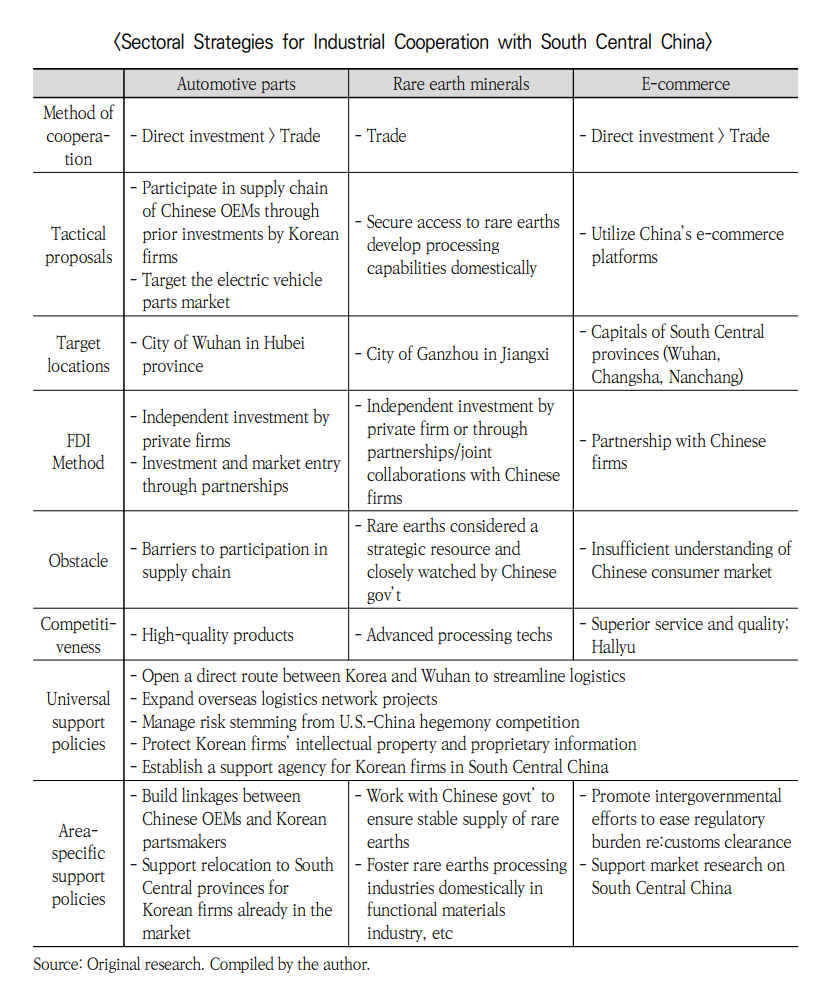
Government support for industrial cooperation in South Central China can take the form of universal policies that cover all potential areas of industrial cooperation and policies tailored to cooperation in individual industries identified as possessing some specific potential.
Universal support policies are proposed as follows. First, it is critical that the government institute support policies that ameliorate the problem of high transportation and logistics costs, a crucial factor that must be considered in any cooperative endeavors in the Hunan, Hubei and Jiangxi regions of South Central China. To this end the government must engage with Chinese authorities regarding the opening of direct transit routes between Wuhan and Korea, the construction of container ports and warehousing facilities, and the creation of designated bonded customs zones for cross-border e-commerce. In addition, the government should help Korean firms enter the market by expanding programs supporting the expansion of overseas logistics networks. Second, Korea must shield its economy, industry and companies from the crossfire in the U.S.-China fight over regional hegemony. The government must carefully manage risk and prevent the consequences of sanctions imposed by either superpower from causing harm to the Korean economy, industry, and businesses. The conflict seems likely to protract over the coming decades, and thus Korea should reexamine its policy of strategic ambivalence. Third, the government should help Korean trade and industry organizations establish a base of operations in South Central China to both support Korean firms already operating there and assist others looking to penetrate the local market. Given the small scale of trade and the relative dearth of Korean firms operating in the region as of now, business booster organizations such as the Korean Chamber of Commerce in China and the Korea International Trade Organization have no presence in South Central China. But if trade were to pick up and Korean companies enter the market, these organizations will need to quickly establish branch outposts..
Policies targeted specific subsectors with good prospects for industrial cooperation are also necessary. Proposals for such policies are described as follows. In order for Korean automotive parts manufacturers to participate in the supply chains of Chinese OEMs, the Korean government must first obtain the cooperation of Hubei government officials. This is because, as with other Chinese automakers — which are considered quasi-national firms — the government of Hubei is a key stakeholder in the local automaker. To this end, practical support measures for networking with Chinese automakers at supplier expos and so forth should also be provided.
Suppliers for Hyundai-Kia in Beijing and Yancheng are struggling with low capacity utilization and need to diversify their client base to include Chinese OEMs. Low-interest loans and or other financial support from local Korean financial institutions should be considered to subsidize the capital investment required to relocate production facilities to South Central China.
In the rare earths minerals sector the first priority should be to establisha close working relationship with the provincial government of Jiangxi and ensure an uninterrupted supply of rare earths. Then an integrated system for the entire extraction and production process must be established, from mining to processing to the manufacture of functional materials using both rare earths inputs and waste byproducts.
In the realm of e-commerce, cooperation between governments on customs and distribution/logistics must precede the market entry of any Korean e-commerce firms. For improving customs regulations that adhere to pilot free trade zone rules, channels for productive cooperation between governments must be secured and discussions held on the protection of intellectual property as it pertains to counterfeit and copycat products. In addition, support for additional consumer market research in South Central China should be provided.

The works on this page are licensed for fair use under the provisions of the Korea Open Government License. See kogl.or.kr for more information.
Please enter the security text below
to prevent email collection

Please check the information of the person in charge.
연구과제 제안이 접수되었습니다.
신청이 접수되었습니다.

View Summary
코로나19 발생 이후 대부분의 고용 관심사가 항공 및 여행서비스, 음식·숙박 서비스 등 주로 서비스 업종에 집중된 상황에서 본 연구는 최근 그 중요성이 강조되고 있는 제조업의 고용변화를 살펴보았다. 분석에 따르면, 코로나19 이후 제조업 고용은 비교적 큰 충격 없이 빠르게 회복하는 모습을 보이고 있다. 제조업 고용은 서비스업에 비해 큰 충격 없이 유지되고 있고, 코로나19 직후 2020년 상반기에 약간 하락하였지만 하반기부터 회복 추세를 보이고 있으며, OECD 주요국의 제조업과 비교하여도 일본과 함께 고용 충격이 비교적 작게 나타나고 있다. 그러나 전반적으로 양호한 고용 성적에도 불구하고 제조업 내 특성 별로는 차이가 나타나는 것으로 보인다. 종사상 지위 별로 보면, 임시·일용직, 고용원이 있는 자영업자에서 고용 충격이 상대적으로 크게 나타났고, 상용직과 고용원이 없는 자영업자는 큰 충격이 없는 것으로 나타났다. 제조업 규모별로는 300인 이상의 경우 코로나 발생 초기 약간의 충격 이후 고용이 빠르게 반등하면서 코로나 이전보다 고용이 더 증가한 반면, 이보다 작은 규모의 제조업체들의 경우 고용 회복이 더디게 나타나고 있다. 고용의 중장기, 단기 추세선을 비교한 결과 제조업 업종에 따른 차이를 보였다. 코로나 발생 이전 3년간의 추세선을 2020년 1월부터 연장한 선과, 2020년 1월부터의 실제 자료를 이용한 단기 추세선을 비교한 결과, 의약품은 코로나19 발생 이전부터 시작하여 코로나19 발생 이후에도 견조한 증가세를 유지하고 있으며, 전자부품·컴퓨터, 기타운송장비, 가구는 코로나19 이후 오히려 고용 추세가 개선되었다. 그러나 다수 업종은 코로나 발생 이후 고용이 하락하였는데, 특히, 비금속광물, 1차금속, 금속가공 분야나 인쇄·기록매체 업종에서 하락이 상대적으로 크게 나타났다.
The following information is provided.
inform@kiet.re.krPlease complete the CAPTCHA below.
[전지적키에트시점] (Eng sub)심상치 않은
국내 대기업 움직임??
KIET 시점에서 보는 미래 로봇 산업 전망은
어떨까요?
경제전문가가 알려드립니다!
(산업연구원 박상수 실장)